
Updated for 2026 | Fact-checked by the Home Décor Ed editorial team | Disclosure: this article contains no paid placements. Products mentioned are named because they’re widely available and well documented, not because of a sponsorship.
U.S. shoppers are on track to spend a record $13.1 billion on Halloween in 2025, up from $11.6 billion in 2024, with decorations alone accounting for roughly $4.2 billion of that total (NRF, 2025). Yard displays have gotten serious enough that Home Depot’s 12-foot animatronic skeleton, nicknamed Skelly, has sold out every single season since it launched in 2020 (Home Depot, 2026; AOL/NY Post, 2026).
If you’ve typed “scariest halloween decorations” into Google looking for something better than the same plastic skeleton every list recommends, this guide is for you. We pulled together real products, real pricing, and actual research on why some decorations scare people and others just sit there looking plastic. There’s a real gap between the two, and most guides don’t explain which is which.
Key Takeaways:
- Motion and sound trigger a measurable startle response that size alone doesn’t (CU Boulder, 2025)
- The scariest Halloween decorations for a yard are different from the scariest ones for an indoor haunted house
- A basic fog machine plus correct lighting angle can outperform a much pricier static prop
- DIY scariest Halloween decorations can compete with store-bought if you get the lighting right
- Skeleton Halloween decorations and tombstone Halloween decorations read best as a matched set, not standalone pieces
- Pacing matters more than prop count in a haunted house walkthrough (Haunted Attraction Network, 2026)
Here’s the full breakdown.
Table of Contents
- What Actually Makes Halloween Decorations Scariest
- Scary Outdoor Halloween Decorations for Your Yard
- Skeleton and Tombstone Halloween Decorations
- DIY Scary Halloween Decorations on a Budget
- Scariest Halloween Decorations for a Haunted House
- Scary Halloween Decoration Ideas for Adults
- Comparison Table
- FAQ
What Actually Makes Halloween Decorations Scary
Quick Answer: The scariest Halloween decorations combine unpredictable motion, sound, and low light because those three cues trigger the brain’s actual startle response, the same reflex behind jump scares in horror films.
Fear, in this context, is the body’s startle response, a defensive reflex involving blinking, an accelerated heart rate, and pupil dilation that fires when the brain’s threat system detects sudden movement or sound (Frontiers in Psychology, 2026). Popular Science spoke with David Zald, a psychologist at Vanderbilt University who directs the Affective Neuroscience Laboratory, who explained that the amygdala lights up whether you’re in a haunted house, on a dark street, or watching a horror film, and that same brain region controls your physical startle reaction (Popular Science, 2021).
A 2025 University of Colorado Boulder study, published in Molecular Psychiatry, built what researchers described as a version of a “mouse haunted house” to study how the brain’s threat system learns when to sound the alarm and when to shut it off (CU Boulder Today, 2025). The core finding lines up with what haunted attraction designers already know from experience: predictable, repeated stimuli stop triggering fear once the brain learns they aren’t dangerous. Novelty and unpredictability are what keep the response alive.
That’s the whole logic behind why a twelve-foot static skeleton photographs well but doesn’t necessarily scare anyone standing in front of it. It’s not moving. It’s not unpredictable. The brain processes it, files it as “not a threat,” and moves on.
The three ingredients that actually matter
- Motion — unpredictable movement reads as alive, which is what triggers the startle response in the first place
- Sound timing — audio that lands right as the movement starts, not before it, is what horror researchers call the classic jump scare structure: a sudden visual intrusion paired with a sudden auditory outburst (Frontiers in Psychology, 2026)
- Lighting — dim, angled, or colored light increases uncertainty about what’s actually in the scene, which sustains the fear response longer than bright, evenly lit displays
Pro Tip: Haunted attraction designers who spoke with Fast Company about Eastern State Penitentiary’s “Terror Behind the Walls” attraction described balancing three elements: scare, spectacle, and story (Fast Company, 2014). You don’t need a full narrative for a front yard, but even one small “story” cue, like a tombstone with a date, gives visitors something to process, which makes the actual scare land harder.
The Home Décor Ed Fear Triangle
Most buying guides focus entirely on the prop and ignore the setup. The Fear Triangle is a simple framework: motion, sound timing, and lighting. A decoration only reaches its full effect when a display addresses all three together. An expensive animatronic under flat, bright porch light will underperform a cheap prop that’s lit correctly, staged with sound, and positioned where it can move.
Self-contained Q&A: Does a bigger prop automatically mean a scarier one? Not according to the research. Size increases visibility, not fear. The startle response is driven by unpredictability and sudden motion or sound, not scale (CU Boulder Today, 2025; Popular Science, 2021).
Scary Outdoor Halloween Decorations for Your Yard
Quick Answer: For a yard, prioritize scariest halloween decorations visible from the street, weatherproof enough to survive an October rain, and staggered at different depths so the display reads as one scene instead of scattered props.
Scary outdoor Halloween decorations are props, lighting, or sound setups built to hold up outdoors, since most visitors experience a home display from the sidewalk or a passing car before they ever reach the door.
Building the scene, step by step
- Map sightlines first. Stand at the curb and note what’s actually visible from there. A prop hidden behind a bush isn’t doing anything.
- Layer by distance. Put the largest, most visible pieces near the street. Home Depot’s giant-scale animatronics, including the 12 FT Skelly ($299) and the newer 11 FT Grave & Bones Mummy, are designed to be seen from a distance (The Home Depot, 2026).
- Add ground fog low and off to one side, not centered, so it drifts naturally instead of pooling.
- Light from below, not above. Uplighting on trees and props creates long, distorted shadows that read as more unsettling than standard overhead porch light.
- Test the display after dark before Halloween night. Daylight testing is misleading. A scene that looks fine at 4pm can look flat, or in the wrong way comedic, once the sun goes down.
That combination of scale, motion, and correct lighting is exactly what turns a big-box animatronic into one of the scariest Halloween decorations available for a street-visible display, rather than just an expensive lawn ornament.
The Home Depot 2026 lineup, for reference
Home Depot’s 2026 Halloween collection launched online on July 16, 2026, with all giant in-store animatronics priced under $300 (The Home Depot, 2026; Haunted Attraction Network, 2026). Notable pieces:
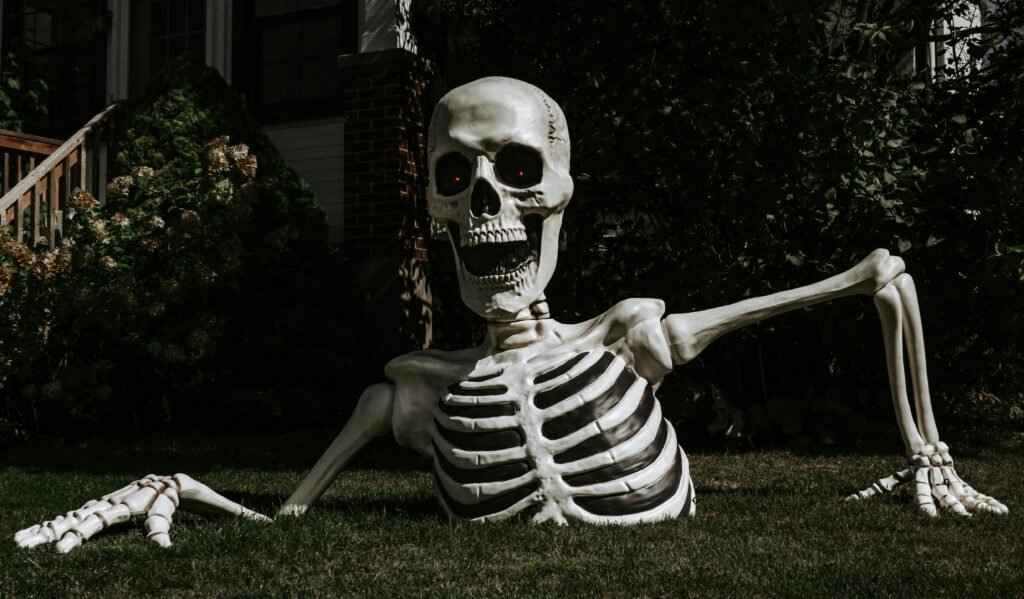
- 12 FT Giant-Sized SKELLY — $299, now app-enabled with customizable head and mouth movement, Bluetooth voice, and 20 LCD eye effects (The Home Depot, 2026)
- 3 FT Mini Skelly — $39.98, a good option for apartments, porches, or smaller yards (The Krazy Coupon Lady, 2026)
- 11 FT Grave & Bones Giant-Sized LED Mummy — new for 2026, motion-activated LED lighting and poseable shoulders (Haunted Attraction Network, 2026)
- 8 FT Wicked Woods Perilous Plant Monster — new for 2026, animated LED (Haunted Attraction Network, 2026)
- 7 FT Lethal Lily — app-controlled, six pre-recorded or custom phrases and five adjustable movement points (The Home Depot, 2026)
Weather and placement mistakes to avoid
- Thin cardboard or plastic tombstones warp fast once exposed to rain
- Extension cords crossing a walkway are a real trip hazard on a night with heavy foot traffic
- Battery-powered props drain faster in cold weather, so plan on rechargeable batteries or an outdoor-rated timer for anything running all evening
Skeleton and Tombstone Halloween Decorations
Quick Answer: Skeleton Halloween decorations and Halloween tombstone decorations work best as a matched set. Mixing collections at random almost always creates a less convincing scene than pairing them deliberately.
Skeleton Halloween decorations cover everything from small tabletop pieces to the twelve-foot animatronic giants that have become a genuine retail phenomenon since Home Depot’s original Skelly launched in 2020 (AOL/NY Post, 2026). Halloween tombstone decorations are grave-marker props, typically foam or plastic, used to build a graveyard scene.
Why the pairing matters
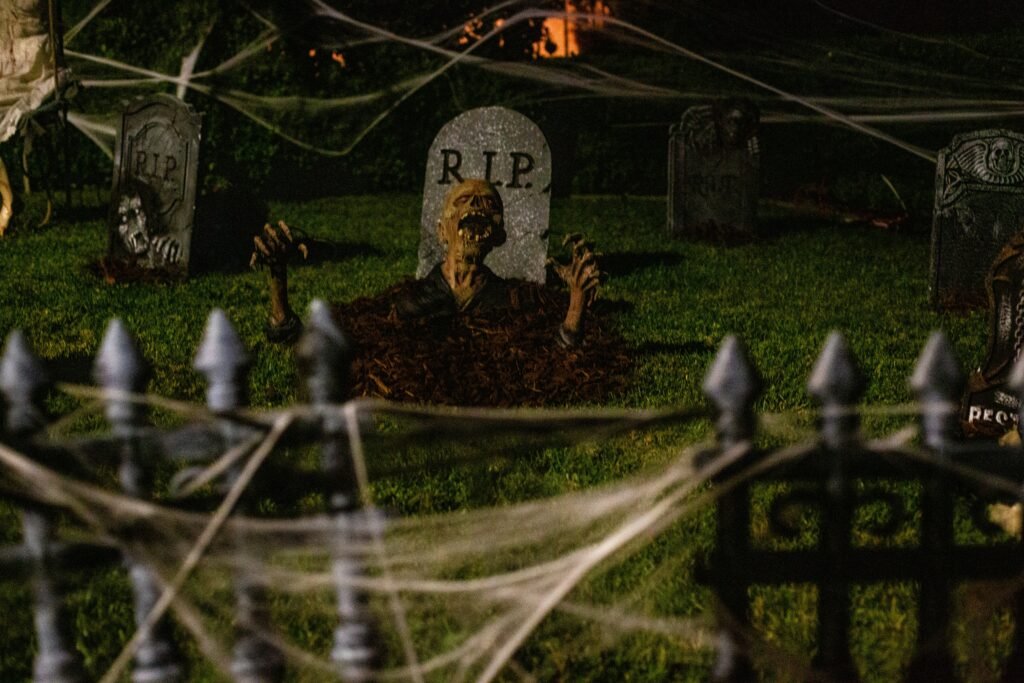
A skeleton without tombstones reads as random. Tombstones without a skeleton read as generic. Together, they imply a story the eye completes on its own: something climbed out of that grave. That’s a version of the “prospect and refuge” idea interior designer Amity Worrel has written about, where haunted spaces work by cutting off a clear view of what’s around the corner, leaving the brain to fill in the blank (Amity Worrel, 2024).
Set up this way, a matched skeleton-and-tombstone scene is consistently one of the scariest Halloween decorations a homeowner can build without paying for a single animatronic.
Setup that works
| Element | Placement | Why It Works |
| Tombstones | Staggered, 3-5 at varying heights | Breaks up an obviously uniform row |
| Skeleton (partial, “climbing out”) | Positioned at the front tombstone | Implies motion without needing an animatronic |
| Ground fog | Low, drifting between stones | Obscures bases and stands |
| Uplighting | Angled from below at 2-3 points | Casts long shadows across the scene |
| Sound | Low ambient loop | Constant low sound sustains tension between jump scares |
Pro Tip: Skip buying five identical tombstones from the same multipack. Mixing in one taller or more weathered-looking stone breaks the “obviously one set from a big-box store” look that undercuts believability.
DIY Scary Halloween Decorations on a Budget
Quick Answer: The highest-impact DIY scariest Halloween decorations come from lighting and sound rather than complex builds, and most cost well under $20 in materials.
DIY scary Halloween decorations are homemade props, lighting setups, or sound effects built without a store-bought commercial decoration. Coohom’s guide to DIY haunted house design notes that realistic room layouts and lighting consistently beat overstuffed, store-bought décor for actual immersion, and that unexpected textures do real work engaging visitors’ senses (Coohom, 2026).
DIY projects worth the effort
- Trash bag spiders. Black garbage bags stuffed with newspaper and tied off in sections. Costs almost nothing and reads as unsettling in low light from a distance.
- Milk jug ghosts. White gallon jugs with simple painted faces, lit from inside with a battery tea light, lined along a walkway.
- PVC pipe “reaching hands.” Garden gloves stuffed with plastic bags, mounted on painted PVC pipe, positioned to look like they’re clawing out of the ground.
- Bedsheet ghosts on fishing line. Suspended from a tree branch, they move slightly in any breeze, which supplies exactly the unpredictable motion the Fear Triangle framework calls for.
- Aged-fabric textures. Coohom’s designer guide recommends old linens soaked in tea for an aged, weathered look as a low-cost way to add convincing texture to DIY props (Coohom, 2026).
That’s part of why budget builds keep showing up in roundups of the scariest Halloween decorations: a well-lit $20 prop can beat a poorly staged $200 one.
Pro Tip: A basic fog machine (Spirit Halloween and other retailers sell 400-watt models built for home use) paired with a low-wattage colored bulb does more for a scene than most single purchased props under $50. Lighting and atmosphere consistently outperform prop count, according to haunted house design guides built around exactly this tradeoff (Coohom, 2026).
Scary Halloween Decorations for a Haunted House
Quick Answer: Scariest Halloween decorations for a haunted house work differently than a yard display because visitors move through a controlled path, so pacing and sound design matter more than any single visible prop.
Scariest Halloween decorations for a haunted house are props and effects built for an enclosed, walkable route where guests move through a set sequence, unlike a yard display viewed from a distance in the open.
Haunted attraction designer Leonard Pickel, writing for the Haunted Attraction Network, makes a specific point about pacing: it’s nearly impossible to stop frightened people mid-walkthrough and get them moving again, so scares should be built to push guests forward rather than stall them, and should come from the back, top, bottom, or sides, never the front (Haunted Attraction Network, 2026). At Eastern State Penitentiary’s “Terror Behind the Walls,” creative director Amy Hollaman described balancing scare, spectacle, and story so the experience isn’t just a string of jump scares (Fast Company, 2014).
Psychology also plays a role in the setting itself. Frank T. McAndrew, a psychology professor at Knox College, told CNN that older-looking spaces are inherently more unsettling, because age implies history, and history implies something might have happened there (CNN, 2018).
Done right, this kind of pacing turns even modest props into some of the scariest Halloween decorations a guest will encounter all night, simply because of when and how they appear.
A working sequence, step by step
- Entry, low tension. Dim lighting and ambient sound, no scares yet, so visitors’ eyes adjust and their guard drops slightly.
- First scare, early and small. A minor scare within the first stretch sets the tone without overplaying it.
- Quiet stretch. A period of tension-building silence or low ambient noise with no active props, since designers note that a sudden drop in sound right before a scare makes the next one land harder (Coohom, 2026).
- Mid-point escalation. A bigger, sound-heavy scare, ideally triggered by guest position rather than a fixed timer so it stays consistent regardless of how fast a group is moving (Homestyler, 2025).
- Emergency exits and clear sightlines throughout. Every credible haunted house design guide treats safety and one-directional flow as non-negotiable, not optional (ProfitableVenture, 2025).
- Finale. The most elaborate moment, positioned right before the exit so it’s the last thing guests remember.
Self-contained Q&A: How wide should a haunted house walkway be? Design guides commonly recommend a clear pathway of roughly 36 to 40 inches, wide enough to avoid crowding while still narrow enough to heighten the sense of confinement (Homestyler, 2025; ProfitableVenture, 2025).
Scary Halloween Decoration Ideas for Adults
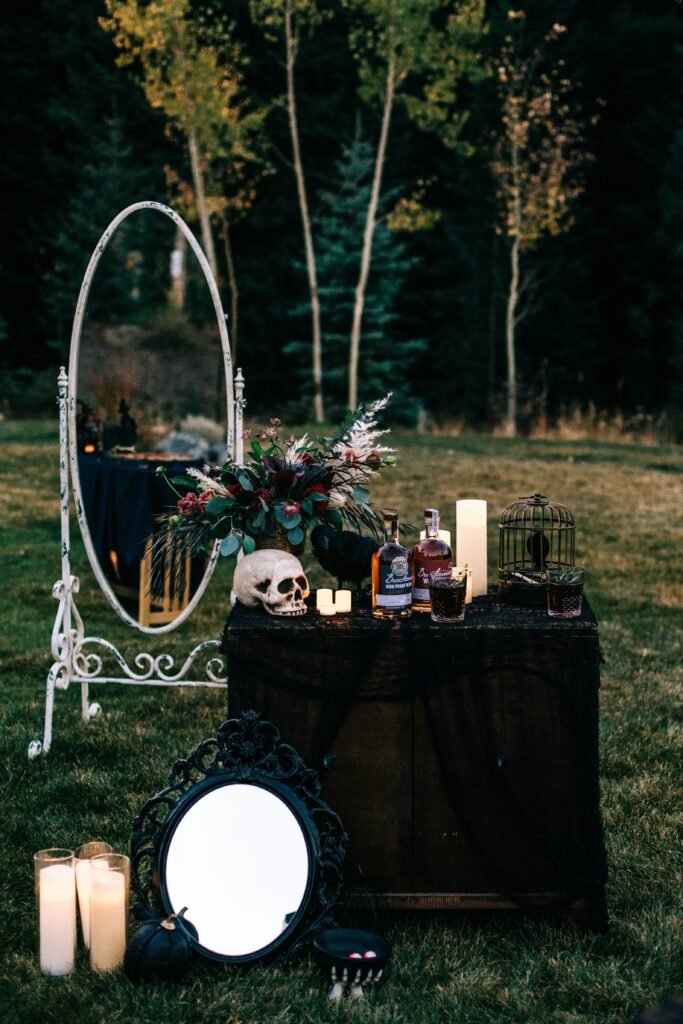
Quick Answer: Scary Halloween decoration ideas for adults tend to favor realism and restraint over cartoonish props, leaning into muted color palettes and atmosphere rather than a yard full of bright plastic skeletons.
Scary Halloween decoration ideas for adults describes décor built for adult-hosted gatherings rather than trick-or-treating children, and NRF’s 2025 survey found that 32% of consumers plan to throw or attend a party this year, with 24% planning to visit a haunted house, both up from 2024 (NRF, 2025).
What separates “adult” from “kid-friendly” in practice
- Color palette. Muted grays, deep reds, and near-black tones instead of bright orange and purple
- Realism over cartoon. A single well-made prop with real texture beats a dozen generic plastic ones
- Restraint. Fewer, better-placed props with negative space between them reads as more deliberate, and often scarier, than a display crammed wall to wall
- Sound design. A low, dissonant ambient track does more for an adult gathering than another jump-scare prop
For an adult crowd, this restrained approach is often what actually produces the scariest Halloween decorations on the block, since a handful of well-placed pieces outperform a yard packed with plastic.
Home Depot’s 2026 lineup leans into this shift too, with adult-party-specific animatronics like “John the Last Call Mixologist,” a bartender-themed prop built for Halloween happy hours rather than trick-or-treaters (Taste of Home, 2026).
To discover more scary ideas for your halloween check out https://homedecoreed.com/halloween-themes/
Pro Tip: Keep the fog machine away from any food or drink table. It’s an easy thing to overlook when you’re focused on the scare factor, but guests will notice fast.
Comparison Table
Scariest Halloween Decorations Comparison: Top Options at a Glance
| Option | Key Feature | Best For | Price | Source |
| Home Depot 12 FT Skelly | App-enabled motion, Bluetooth voice, 20 LCD eye effects | Street-visible yard displays | $299 | The Home Depot, 2026 |
| Home Depot 3 FT Mini Skelly | Same design, smaller footprint | Apartments, porches, small yards | $39.98 | The Krazy Coupon Lady, 2026 |
| Home Depot 11 FT Grave & Bones Mummy | Motion-activated LED, poseable shoulders | Graveyard-themed scenes | Under $300 | Haunted Attraction Network, 2026 |
| Spirit Halloween 400W Fog Machine | Burst fog, timer-compatible | Any outdoor scene | Check current retail price | Spirit Halloween, 2026 |
| DIY PVC reaching hands | Custom placement, near-zero cost | Budget yards, walkways | Under $20 in materials | Home Décor Ed estimate |
| Home Depot 7 FT Lethal Lily | App-controlled phrases and movement | Adult party displays | Under $300 | The Home Depot, 2026 |
Our pick: The 12 FT Skelly earns the top spot for yard displays specifically because it satisfies all three points of the Fear Triangle on its own, motion, app-controlled sound, and adjustable LED eyes, while staying at a fixed, published price point every season (The Home Depot, 2026). For anyone on a tighter budget, pairing the DIY reaching hands with a basic fog machine and correct lighting angle gets close to the same effect for a fraction of the cost.
Note: prices and product availability change season to season and by region. Confirm current pricing directly with the retailer before publishing or purchasing.
FAQ
What are the scariest Halloween decorations you can buy right now? Animatronic props with motion sensors and app-controlled sound, like Home Depot’s 12-foot Skelly, consistently draw the most attention because they react to movement instead of sitting still. Static props, no matter how large, tend to underperform smaller reactive ones, which lines up with what fear research says about the startle response being driven by unpredictability rather than scale.
How does a fog machine actually make decorations scarier? Fog obscures the base of props, hiding stands and cords that would otherwise break the illusion. Positioned low and off-center, it drifts naturally across a scene and adds visual uncertainty, and haunted house design guides consistently point to atmosphere and lighting as bigger factors in a scene’s effectiveness than prop count alone.
Why is lighting more important than the prop itself? Lighting controls what people can actually make out in a scene, and dim, angled, or colored light increases the ambiguity that sustains a fear response. Haunted attraction design guides treat lighting and shadow play as core tools, not afterthoughts, right alongside the props themselves.
Is it worth spending money on animatronic props, or is DIY good enough? That’s the core tradeoff behind almost every roundup of the scariest Halloween decorations bigger, reactive props cost more, while DIY builds cost far less and can still deliver a strong scare with the right lighting. For most homeowners, DIY scary Halloween decorations paired with a fog machine and colored lighting can get close to the same visual effect for far less money. Animatronics are worth the investment specifically for high-traffic yard displays or haunted house entry points, where consistent, repeatable motion and reliability matter more than a one-off setup.
What’s the best way to set up scary outdoor Halloween decorations if I only have a small yard? Focus on layering depth instead of width. Staggered tombstones, low fog, and angled uplighting create the impression of a deeper scene than the actual square footage would otherwise suggest.
What’s the best way to make a haunted house actually scary instead of just cluttered? Space out scares and build in deliberate quiet stretches, since haunted attraction designers specifically warn against skit-based rooms that stall foot traffic and against scaring people from directly in front, which tends to stop them rather than move them forward.
How much should I expect to spend on scary Halloween decorations for a yard? It varies widely, but NRF’s 2025 survey put total U.S. decoration spending at roughly $4.2 billion overall, and a single giant animatronic from a major retailer typically runs under $300, with smaller props and DIY elements adding far less on top of that.
My decorations look scary in daylight but flat at night. What’s going wrong? This almost always comes down to lighting angle. Overhead or front-facing light flattens shadows and kills the effect. Switch to low, angled uplighting and test the full display after dark before Halloween night, not during the day.
Conclusion
The scariest Halloween decorations aren’t necessarily the biggest or the most expensive ones. They’re the ones that move unpredictably, time their sound correctly, and get lit from the right angle, which is the whole idea behind the Fear Triangle framework covered earlier. Research on the startle response backs this up directly: unpredictability, not scale, is what drives the reaction (CU Boulder Today, 2025).
Ready to build your own scariest halloween decoration display ? Here’s what to do in the next 10 minutes:
- Walk your yard at dusk and note which spots are actually visible from the street
- Pick one prop and one lighting change from this guide to test tonight, not on Halloween itself
Start small, test it in the dark, and adjust from there.
Author Bio
This guide was written and fact-checked by the Home Décor Ed editorial team, drawing on published research from psychology and neuroscience researchers, professional haunted attraction design resources, and current retail data from major Halloween retailers. We update this guide each season as new products launch and pricing changes. Questions or corrections can be sent through our contact page.
References
- National Retail Federation, “NRF Consumer Survey Finds Halloween Spending to Reach Record $13.1 Billion,” 2025 — https://nrf.com/media-center/press-releases/nrf-consumer-survey-finds-halloween-spending-to-reach-record-13-1-billion
- The Home Depot, “The Home Depot Debuts 2026 Halloween Collection,” 2026 — https://corporate.homedepot.com/news/products/the-home-depot-debuts-2026-halloween-collection
- Haunted Attraction Network, “Home Depot Halloween 2026: Every Animatronic,” 2026 — https://hauntedattractionnetwork.com/home-depot-halloween-2026-collection/
- The Krazy Coupon Lady, “Home Depot Skelly,” 2026 — https://thekrazycouponlady.com/tips/store-hacks/home-depot-skeleton
- AOL/NY Post, “Skelly the 12-foot skeleton decoration is back at Home Depot,” 2026 — https://www.aol.com/entertainment/skelly-12-foot-skeleton-decoration-173819682.html
- CU Boulder Today, “‘Jump scare’ science: Study explains how the brain responds to fear,” 2025 — https://www.colorado.edu/today/2025/10/30/jump-scare-science-study-explains-how-brain-responds-fear
- Popular Science, “What makes jump scares effective?,” 2021 — https://www.popsci.com/science/why-jump-scares-are-effective/
- Frontiers in Psychology, “(Re)Considering the jump scare in four elements,” 2026 — https://www.researchgate.net/publication/399501159_ReConsidering_the_jump_scare_in_four_elements
- Fast Company, “The Architecture Of Fear: How To Design A Truly Terrifying Haunted House,” 2014 — https://www.fastcompany.com/3037618/the-architecture-of-fear-how-to-design-a-truly-terrifying-haunted-house
- CNN, “The art and psychology of haunted house design,” 2018 — https://www.cnn.com/style/article/haunted-houses-architecture-psychology
- Haunted Attraction Network, “Designing a Fright Attraction from the Inside Out” — https://hauntedattractionnetwork.com/haunted-attraction-designing/
- Amity Worrel, “Haunted House Design 101,” 2024 — https://amityworrel.com/2024/10/17/the-movie-set-design-principles-that-make-horror-movie-houses-scary/
- Homestyler, “How to Design an Immersive Home Haunted House,” 2025 — https://www.homestyler.com/article/how-to-design-an-immersive-home-haunted-house
- ProfitableVenture, “Haunted House Design Ideas With Floor Plan and Room Layout,” 2025 — https://www.profitableventure.com/haunted-house-design-ideas/
- Taste of Home, “The Home Depot’s 12-Foot Giant Skeleton Is Back,” 2026 — https://www.tasteofhome.com/article/giant-skeleton/